Showing posts with label advergaming. Show all posts

Tuesday, April 21, 2009

Lego Continues to Successfully "Build" Brand Through Video Games

Following in the footsteps of Lego Star Wars, Lego Indiana Jones and Lego Batman comes Lego Rock Band, which was formally announced today.

Lego is not new to branded video games, having been in the space since 1998. However, since the success of the original Lego Star Wars, the brand has seen huge gains in both their game sales and more importantly, the sales of Lego blocks.

In terms of game sales, the Lego Star Wars series of video games alone have sold over 19 million copies, Lego Indiana Jones has sold almost 8 million copies, and Lego Batman has sold over 4 million copies. And how has this new wave of Lego video games boosted block sales? Sales were up 38% in 2008 even in the face of the economic downturn.

Where does Lego succeed in the video game space where other brands fail? Let's discuss.


The gamer in me instinctively wants to say that the plan works because the games don't suck. While they're not perfect, the games achieve an acceptable level of quality, unlike most advergames (including every Lego game before Lego Star Wars). The ad guys and gals of the world take this part for granted, and I hope in the future that they don't. The power of interactive advertising lies in the fact that you can associate your brand with a positive experience. If you give the consumer your brand and tie it to a negative experience, odds are they'll think negatively about your brand. Even kids have standards for video games and are looking for a positive experience, and a poorly developed game will get shunned the moment the game isn't fun anymore.

The marketers not well versed in the world of video games would probably say it sold because it was attached to popular licenses. Yes, having Star Wars, Indiana Jones and Batman helps quite a bit. However, if it was just the license association selling the games, then the increase in Lego block sales would only affect the Star Wars, Indiana Jones and Batman product lines. As big as those are, I don't think they're big enough to pull in the type of gains that Lego had in 2008. And they would have explicitly said their gains came from just those lines, which they didn't.

So what then makes these games sell more Lego blocks?


Let's break it down with the Anthony Kalamut classic, 1+1=3.
1+1=3
Client/Product/Brand Insights + Consumer/Audience Insights = Sweet Spot/Big Idea/Execution
Lego blocks have for many years been a childhood staple. To kids, they are more than just blocks. You're building ideas. You're taking an idea in your head and making it come to life.
+
Children love to play. They love to pretend. They love to make things and use their imagination.
=
Fun, virtual and interactive Lego experience.

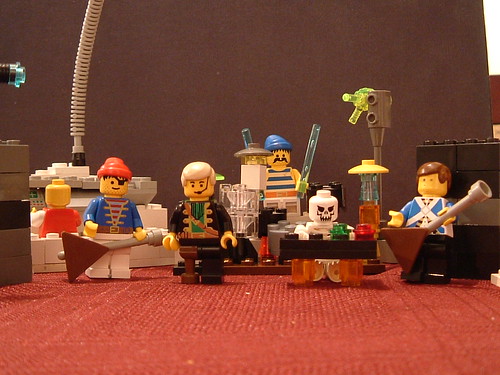
Every game in the "Lego" lineage captures the experience of playing with Lego blocks. All the characters look and move as you would imagine Lego people would. They fall apart into Lego blocks when "killed". Lego characters in these games never die, they just get put back together. The Lego pieces never talk, but they emote so vividly that they can convey an entire story without actually talking. Just like playing with Legos in real life, your Lego pieces never talk, it's up to you to think/say what your Lego people will say. The games feature a lot of building elements. And even within the framework of a popular series like Star Wars, they allow room for children to use their imaginations and make their own fun. Everything fun about playing with Lego blocks, they were able to translate into these games and inspire the youth of today to invest in the brand even further.

Lego has managed to put together the pieces of the advergaming puzzle to form something that works very well for their brand (sorry for the unavoidable pun). It'll be interesting to see how successful Lego Rock Band will be. Unlike the other games in the current Lego series, this one is a music game and not an adventure, and I feel that adventure lends itself better to the Lego experience. However, Google search has just exploited the limits of my imagination, by proving that lots of people have been rocking out with their Lego pieces. Lego, if you're listening, all I ask for is some sort of nod to the brilliant video for "Fell In Love With A Girl" by the White Stripes.


READ MORE

Saturday, April 11, 2009

iPhone It In: The Difference Between Good and Bad Advertising Applications

Yesterday, Apple began a countdown towards 1 billion downloaded iPhone and iPod Touch applications. As an iPod Touch owner, the applications turned my unnecessarily expensive iPod into the Swiss Army Knife of gadgets I couldn't live without.

It's been an extremely popular platform for games, social networking and...fart noises. But when used properly, it also makes a great advertising platform.

There are a number of ways to advertise through the iPhone, even within the more specific framework of an application. Do you run banners on another application? Do you make your own application? Or is there some other form of solution you can think of? The rabbit hole is pretty deep, and we're still just scratching the surface.

From my time downloading applications and going out of my way to check out the advertising related ones, I've found that if an advertiser is going to release their own application, it better provide a compelling experience for it to achieve any sort of effectiveness.

One of the better advertising applications that I think achieves that is Spin the Coke Bottle by Sapient. It's a really basic application that is as frivolous as it gets and I don't think is tied to any concept or promotion (other than its release near Valentines Day), but the experience it provided was just compelling enough to be effective.

I can't say that I've gotten any action thanks to Spin the Coke since I got this application, but it hasn't stopped me from bringing it out when I have friends around. We have a few laughs for a couple of seconds and put it away. But as the owner of the iPod, that experience was compelling enough for me to use multiple times and keep on my iPod to mess with in the future. Even when I'm not using it, that Coke button on my menu is like having a Coke billboard in my pocket that I see multiple times a day.

On the other end of the spectrum, something like FedEx Mobile seems ultra useful while still providing a engaging experience. I don't ship out packages much, so I haven't downloaded this application. However, during the few times I have shipped out parcels (R.I.P. XBOX 360), being able to check where they are at all times in the palm of my hand is a feature I would highly value. A feature like this would definitely alter my buying decision.

For both Coke and FedEx, those experiences are more than just another means of traditional brand advertising. You can still achieve that awareness through your application, but it's also a great opportunity to give the consumer a valuable experience in return. When you give them that valuable experience, you build a healthy relationship with your consumers who in return will be more likely to invest or reinvest in your product or service.

You can pass on this one.

On the other side of the coin, without that compelling experience, all of the branding and reach in the world will not save your application. I can point to a number of bad automaker advergames to prove this point. Give the consumer a poor experience, and you've offended them worse than you would have with an ad on any form of traditional medium that they just didn't like.

They went out of their way to download your application. When that experience is not to their standards, they're almost offended in a way. To them, your bad application means you wasted their time, their iPod memory and maybe even their money if it was a paid application. One of those automaker advergames almost broke my iPod when instead of loading the game, all it did was display an all-white screen I couldn't get out of. They'll quickly delete it, give it a poor rating on iTunes to tell others not to download your application and maybe sour the relationship you once had with a customer that went out of the way to receive your advertising message.

Those that get the importance of the experience will thrive in this space. Those that don't won't get much more than a few thousand 1-star reviews and a lot of potential customers lost.


READ MORE